
 English (United Kingdom)
  Arabic (اللغة العربية)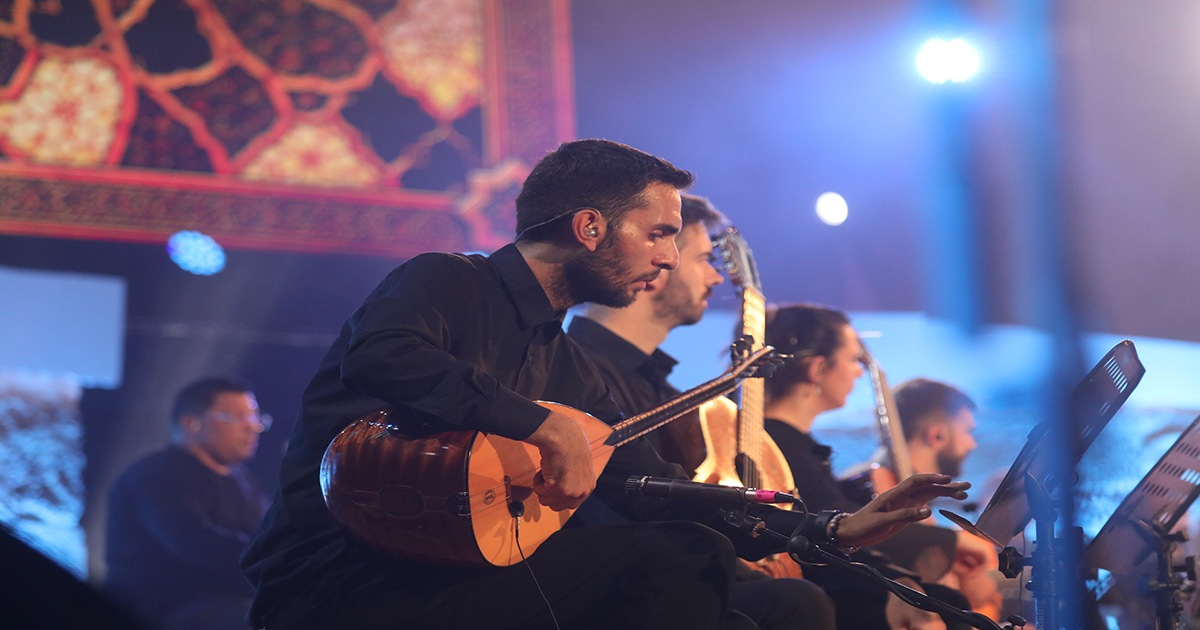
From the very beginning of his career, Sami Yusuf chose to turn the stage into a space for contemplation, treating music as a spiritual language that seeks to connect with humanity, regardless of culture, language, or belief. During the 60th edition of the Carthage International Festival, the encounter on the evening of Saturday, August 1, 2026, between the artist and the venue felt natural. The ancient theatre, with its layers of civilization and history, did not merely host a voice; it welcomed a musical project that, for over two decades, has been building bridges between East and West, between tradition and modernity, and between spiritual chant and contemporary musical composition.
As Sami Yusuf's voice resonated like a call or a hymn inviting the audience to his spiritual world, the musical instruments accompanied him with subtlety, embracing his voice as it soared across the space. Gradually, a fusion of rhythms and melodies took shape, breaking boundaries through the interplay of diverse musical instruments, languages, and colours that manifested on the stage of Carthage's ancient theatre, transforming it into a symbolic space uniting different nationalities under the banner of music.
The stage was adorned with "Marqoum"—that Tunisian imprint carrying intricate ornaments and colours—which became part of a visual fabric, an extension of the sonic fabric whose philosophy the audience embraced. When Sami Yusuf's voice rose with "Madad," the audience responded, hands raised in supplication, as music and voice intertwined in a prayer to the Divine, dissolving the boundaries between the stands and the stage, uniting every breath in devotion.
The more Sami Yusuf immersed himself in his artistic space, the clearer it became that he defies classification within a single musical mould. He possesses a cohesive musical identity that goes beyond mere "fusion" to establish a unique language that belongs only to him. He borrows the maqamat of Arabic music, the transparency of Persian music, the orchestral structure of the Western classical school, while opening his doors to the rhythms of the Mediterranean, Central Asia, and the Balkans. It is a sonic mosaic, enhanced by the presence of other voices on stage—Moroccan artists Ismail Boujia and Nabila Maan, and Spanish artist Isra Moro—who added their unique vocal imprints that intersect with his spirituality.
From the stage of the Carthage International Festival, Sami Yusuf chose to evoke the tragedy that Gaza has endured for over three years, condemning the genocide, singing: "And we love life, whenever we can find a way to it." The words of Palestinian poet Mahmoud Darwish echoed through the ancient theatre, carried by music that oscillated between calm and revolution. As the words flowed, telling the story of resistance with profound poetry, music from the heart of Palestine seeped through, and the audience's applause rose as they grasped Sami Yusuf's message, chanting: "Free Palestine."
What distinguishes Sami Yusuf's artistic experience is that it does not rely on showcasing vocal technique or dense musical arrangements as much as it does on creating an emotional state. His voice is a means to reach meaning, which is why his works seem to move at a deliberate, slow pace, allowing music to breathe and words to settle in the listener's heart. When he sang "Hasbi Rabbi," Yusuf found that this piece had never left the memory of his Tunisian audience, who turned into a choir sharing the song and the rhythm, knowing exactly when to fall silent and when to continue.
From the songs that made him famous to his more contemporary works, a clear transition can be observed from traditional spiritual song to compositions more open to world music, without ever abandoning his humanistic essence. Each stage of his career seems to extend from what came before, not a break from it, which has given his musical world a rare balance between fidelity to identity and a constant desire for experimentation. This musical choice is inseparable from his vision of music as a space where beauty meets human values. His works frequently intersect with poetry, philosophy, Sufism, and the search for meaning, turning each song into a deep inner and emotional journey.
Lighting and scenography transcend their role as accompanying elements to become part of the visual narrative that parallels the musical narrative, in a precise relationship between light and sound, between moments of silence and the whisper of a note. With a diverse audience moving in sync with the rhythm of the performance, fully aware of when to settle into quiet contemplation, when to applaud, and when to become partners in singing, the concert transformed into a space for lyrical dialogue, where boundaries dissolved before the language of art.
The distinctiveness of Sami Yusuf's artistic project lies in the fact that he does not simply balance East and West; he creates a third space, where Eastern maqamat coexist with Western harmony, and spirituality meets contemporary musical composition. In an age of speed and noise, the world-renowned artist Sami Yusuf reminds us that music can be an act of listening, and that art is another path to understanding humanity and the world. And in Carthage, where ancient stones intertwine with the present, this project takes on an additional dimension, giving music a visual and spiritual depth, and making the performance a complete sensory experience that lingers in memory as a hymn to beauty, peace, and humanity.